
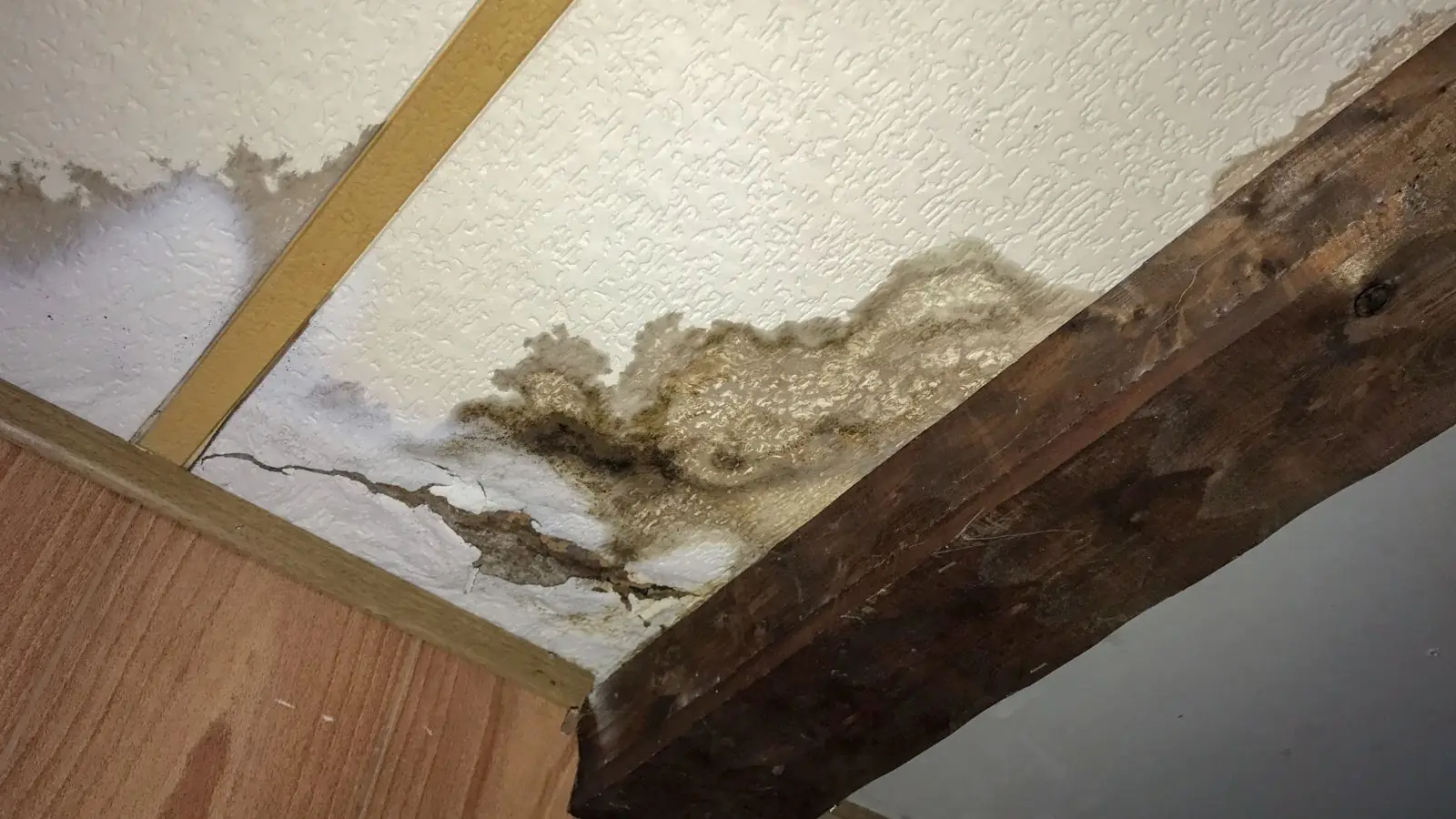
A roof leak is an emergency the moment water is moving through the ceiling. The 24/7 dispatch line is open during storms, at night and on holiday weekends, and the person who answers walks you through protecting the room until a truck is on its way. Our work is the water that got inside, meaning wet insulation, framing and drywall. Patching the roof itself belongs to a roofer.
While you wait, slide furniture out from under the drip, set a bucket below it and lay plastic sheeting over anything too heavy to move. Take photos of the stain and the drip before anything is touched. We try to get out the same day when a crew has room, and if the schedule is full you hear that on the first call.
When a roof leak becomes a water damage emergency
One drip into a bucket is a warning. It becomes a loss when water keeps arriving, when the ceiling sags or when the insulation above the ceiling has soaked through. Wet fiberglass or cellulose holds water against the drywall for days, so the ceiling keeps getting wetter after the rain stops.
Yucaipa has a Mediterranean climate, which climate summaries describe as rain falling mostly in winter with hot dry summers. A roof can sit dry for months, so the first heavy storm after a long dry stretch is often when a failed flashing or a cracked tile finally shows itself. Walk your ceilings after that first storm instead of waiting for a brown ring to appear.
Reading the ceiling after a roof leak
The stain on the ceiling is rarely where the roof is open. Water runs along rafters and the top of the drywall before it drops, so the source can sit several feet from the spot you see.
| Ceiling clue | Likely meaning | Your move |
|---|---|---|
| Brown ring on the ceiling | Water has passed through at least once and may still be wet above | Check the attic side if you can reach it safely, and call if the ring grows |
| Bulging or sagging drywall | Water has pooled on top of the board | Keep people out from under it and call now |
| Drip only while it rains | An active opening, often at a flashing, vent or valley | Catch the water, protect belongings, call a roofer and us |
| Musty smell in a hall or closet | Insulation or framing stayed wet | Moisture readings are needed before anything is closed up |
| Stain appears days after rain | Water traveled along a rafter before it dropped | The wet area is larger than the stain |
| Peeling paint at the top of a wall | Moisture has reached the wall top plate | Open the wall edge and check the cavity |
Roof leak safety in the first hour
A ceiling that bulges can release a lot of water and wet drywall at once. Keep people and pets out from under it, and call us before anyone opens it. Do not climb onto a wet roof to look for the hole, because a fall is a bigger problem than the leak.
- Water inside a light fixture or ceiling fan housing is an electrical hazard. Flip the breaker for that room only when the panel is dry and you can stand on a dry floor to reach it.
- If the panel is wet, or you see sparks or smell burning, get out and phone 911 or the electric company first, then ring us.
- Do not turn on a ceiling light that has water in it, even to see better.
- Photograph the ceiling, the drip and anything damaged before cleanup. Date-stamped photos help later.
- Call a roofer for a temporary cover. We dry the building but do not repair roofs.
How we remove roof leak water
A technician starts below the stain, takes moisture meter readings and scans the ceiling with a thermal imaging camera, then follows the water path up into the attic where access allows. Cold patches on the thermal image mark wet insulation and framing that the surface hides. That map decides what is dried in place and what has to come out.
Find the water path
Moisture meter and thermal imaging camera trace the leak from the ceiling stain back toward the opening.
Extract and open
Wet vacuums pull standing water, soaked insulation is bagged and a small access cut lets air reach the cavity.
Dry the structure
Axial air movers and LGR dehumidifiers run for days, with a HEPA air scrubber if drywall dust is released.
Confirm with readings
Readings repeat each day against a dry reference until the numbers match, and then the written scope passes to repair.
Insulation is the item most often replaced, because it holds water and loses its value once matted. Drywall that stayed wet beyond a day or two is usually cut out as well. The same readings that tell us when to stop also tell you what was saved, which keeps the rebuild honest. For the drying stage in detail, see water mitigation.
Ceiling dripping right now?
Call the dispatch line, describe the drip and the ceiling, and we will explain how to protect the room until a crew rolls.
What changes the cost of roof leak cleanup
- How much of the attic insulation is wet and has to be removed and replaced.
- How many ceiling and wall sections must be opened to reach framing.
- Days of drying equipment, which depend on materials and how long the water sat.
- Access, since a low attic with tight framing takes more labor than an open one.
- Rebuild work afterward, such as drywall, texture and paint, priced as its own stage.
Want your real number? Call (909) 505-3870. The price and scope are explained before work starts, so you can compare them against what is done.
Insurance and roof leaks
Many homeowners policies treat a storm that opens the roof as a sudden and accidental loss, and the water damage inside may be covered. Leaks from worn roofing that was never maintained are often treated differently. Flood is usually excluded and needs its own policy, which does not apply to rain coming through the roof.
Go through your policy with your insurer before you file anything. We never promise approval or payouts, and we do not name carriers. What we can give you is the moisture log, photos and written scope, which make the conversation simpler.
Local notes for Yucaipa homeowners
In 2022, after Tropical Storm Kay, news reports out of the Oak Glen area north of town covered hard rain and mud. That event was about runoff, not roofs, yet it shows how fast rain can turn serious here. Check flashings, gutters and downspouts before the wet season, not during the first storm.
For a structural repair, the City of Yucaipa Community Development department is the office to ask about permits. Homes in Mentone, northwest of Yucaipa, fall under San Bernardino County instead of a city, so the county is the office to call. Over in Redlands, the permit counter is the city's One Stop Permit Center.
Mistakes to avoid after a roof leak
- Painting over a stain. Paint hides the ring but leaves wet material behind it.
- Leaving soaked attic insulation untouched because the ceiling seems fine from below.
- Closing the opening after a roof patch with no moisture readings. Trapped water is how small leaks become bigger repairs.
- Waiting for the next rain to see if it comes back. The wet materials keep damaging themselves in the meantime.
- Running one household fan and calling it dry. Cavities need controlled airflow and dehumidification.
Published guidance gives you a clock: the EPA points to a 24 to 48 hour window before wet materials invite trouble. Crews that follow ANSI/IICRC S500 document their readings, so ask for them. After the roof is fixed and the structure is dry, water damage repair rebuilds the ceiling.
Roof Leak Cleanup Questions
Day or night, even in the middle of a storm. Call and we explain how to protect the room, then send a crew as the day allows. Should the schedule be packed, you hear that before anything else.
No. We remove and dry the water that came inside, then hand off to repair. A roofer handles the opening. Having the roof sealed first keeps new water from undoing the drying.
Matted insulation usually does not dry well and is removed. Framing and drywall around it dry over several days with air movers and dehumidifiers, and readings tell us when it is done.
You can, but the materials keep absorbing water meanwhile. Calling during the storm lets us tell you how to limit the damage and start planning the visit.
Not always. If a ceiling was wet only briefly and its readings return to normal, sealing the stain and repainting may be all it needs. Drywall that sags, bubbles or turns soft is usually cut out.
Sudden storm damage is often covered, while long-term wear often is not. Check your policy or ask your insurer, and keep photos and receipts.
Still have a question?
Call the 24/7 emergency line and ask. Scope and price are explained before work starts.