
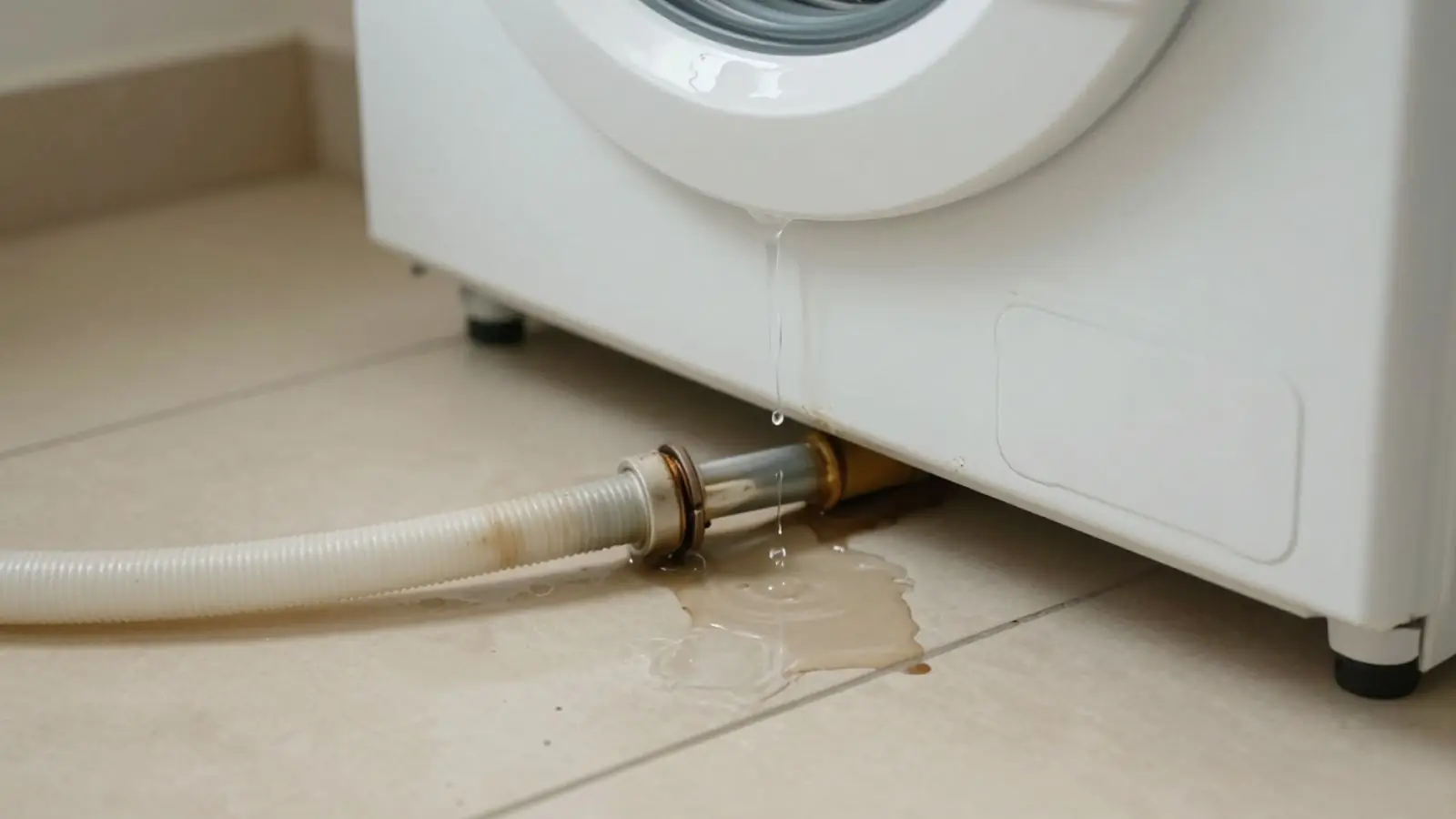
An appliance leak starts inside or behind a machine, so the water often spreads for days before anyone sees it. Appliance leak water damage cleanup is the job of finding that water, drying the floor, cabinets and walls it reached, and telling you what can stay. The 24/7 line takes the sudden ones, such as a split washer hose, and the slow ones go the same way.
Where appliance leaks come from
Washing machines leak from fill hoses, drain hoses and worn pumps. Dishwashers leak from door gaskets, supply lines and drain connections. Refrigerators leak from ice maker lines and defrost drains that clog and overflow onto the floor. A rubber or old braided hose can fail with no warning, and a loose clamp can drip for months.
Where the machine sits changes the damage. A laundry closet traps water against the framing, a kitchen dishwasher sends it under the cabinets and a fridge pushes water beneath the flooring. In all three, the water you can see is the small part.
Your water bill names your provider, and a sudden jump in usage with no change in habits can point to a hidden leak.
The Yucaipa Valley Water District, listed in a LAFCO staff report as the provider for Yucaipa and Calimesa, is one of two districts you may see on a bill around here. In Beaumont and Cherry Valley the bill often comes from the Beaumont-Cherry Valley Water District instead, so check which one you receive. Homes in Beaumont and Calimesa get the same service from us.
Clues that a machine has been leaking
| Symptom | Probable source | Next step |
|---|---|---|
| Musty smell in a laundry closet | A slow drip into the floor or wall | Close the supply valves and call |
| Warped flooring near the fridge or dishwasher | Water has been under the flooring for some time | Do not pull the machine, call first |
| Soft spot or stain under the dishwasher | A door gasket, drain or supply leak | Close the valve under the sink |
| Bubbling vinyl or lifting tile edges | Moisture in the subfloor | Keep foot traffic off and call |
| Stained cabinet floor or swollen toe kick | Water has been moving through the cabinet base | Empty the cabinet, close the valve |
Safety in the first hour with a leaking machine
- Close the supply valve to the machine. Washers have hot and cold valves, dishwashers have one under the sink and fridges have a small line valve.
- Unplug the appliance only if the floor around the outlet is dry. If water reached the outlet, stay back and phone 911 or the electric utility.
- Do not tip or drag a fridge or washer across a wet floor, since the weight can crack tile and the cords can pull loose.
- Mop or extract the surface water, and lift rugs and boxes.
- A gas odor near a dryer or range means you walk out and phone 911 or the gas company.
- Photograph the machine, the hose and the water before you move anything.
How we handle an appliance leak
A technician traces the water from the machine outward with a pin-type moisture meter and a thermal imaging camera. The camera shows cold wet areas beneath flooring and inside cabinets that look dry on top.
Pull and extract
Once the machine is safe to move, extraction units and wet vacuums clear the floor and the cavity beneath.
Check
Moisture meters test the toe kick, cabinet base, drywall and subfloor edge.
Open
Toe kicks and baseboards come off, and a section of wall or flooring is opened only if readings demand it.
Dry
Air movers, mat drying systems and a dehumidifier run until readings are back at dry reference levels.
An appliance repair technician or a plumber fixes the hose, gasket or line, and we dry the damage. If the leak ran under kitchen cabinets, kitchen water damage restoration covers the rebuild options, and a split supply line that flooded a larger area is a burst pipe case.
Water under a machine and not sure how far it went?
Call the 24/7 line. A coordinator asks a few questions about the machine and the floor, then lays out the next steps and the scope and price before any work is started.
Cost factors in appliance leak cleanup
- How long the leak ran, since hidden drips mean more material is wet.
- The flooring under and around the appliance, and whether it can stay once it is dry.
- Whether cabinets, drywall or insulation need opening.
- How many days drying equipment runs, based on the readings.
- The rebuild after drying.
Want your real number? Call (909) 505-3870 and tell us the appliance and the flooring.
Insurance, sudden and gradual leaks
Appliance leaks are often where the sudden versus gradual question gets decided. A hose that bursts and floods a room is often covered, while a drip that ran for weeks is often treated as maintenance, and the appliance itself is usually outside the claim. Ask your insurer, keep the failed hose if you can and keep every receipt, since approval is not ours to promise.
ANSI/IICRC S500 is the published reference that sorts water into Categories 1 to 3, and a leak from a supply hose is usually clean water at first but can change category if it sits against porous materials for days.
Prevent the next leak and skip these mistakes
- Replace rubber washer hoses with braided ones, and check the age of existing hoses.
- Do not run a washer or dishwasher while the house is empty for days.
- Pull a machine out once or twice a year and look at the floor behind it.
- Do not wait for the smell. A musty laundry closet means moisture is already in the framing.
- Do not close up a wet cabinet or closet. Trapped moisture is how a small leak becomes a mold problem, and EPA guidance treats 24 to 48 hours as the window to get materials dry.
Appliance Leak Questions
Yes. Washers and dishwashers do not leak on a schedule, so the 24/7 line is open for nights and weekends. Dispatch follows the order of incoming calls with no promised arrival time, so shut the machine's valve and use the safety steps in the meantime.
No. An appliance technician or plumber fixes the machine and its lines. We extract water, check the floors, cabinets and walls and dry them.
A fan helps the surface only. Water under flooring, in the toe kick or inside the wall stays wet. A moisture meter tells you what is dry and what is not.
Call, and do not pull the fridge across the floor. A slow leak usually means moisture under the flooring and in the subfloor, and the crew will check before deciding what comes up.
A sudden failure is often covered for the water damage, while a slow leak often is not. Policies differ, so ask your insurer before you file.
Still have a question?
Call the 24/7 emergency line and ask. Scope and price are explained before work starts.