
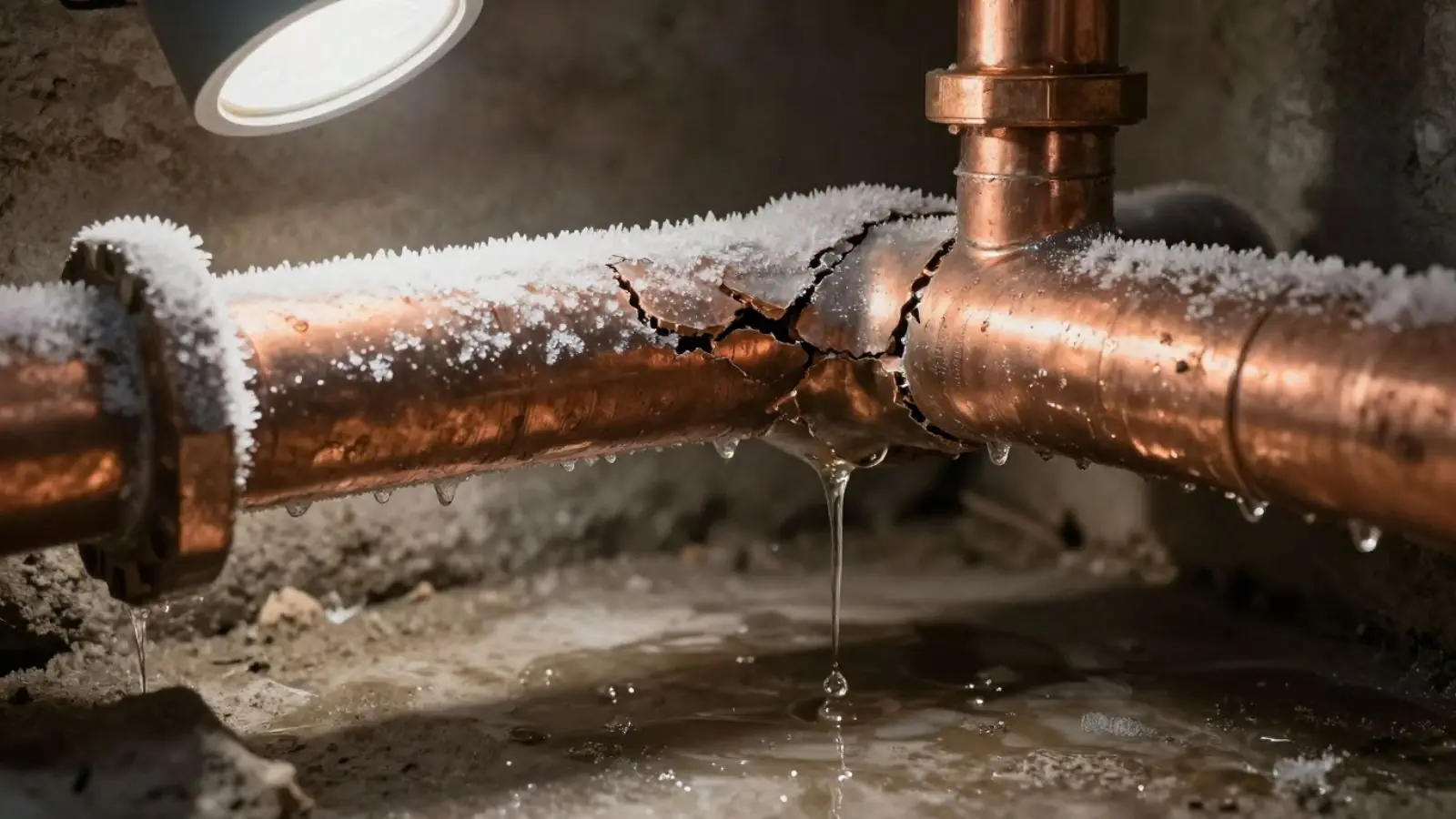
Frozen pipe damage restoration deals with what happens after ice splits a line and the building warms up. Water freezes in a pipe, expands and cracks the metal or plastic, and the crack stays quiet until the ice melts. Then the line leaks at full pressure inside a wall, an attic or a garage. The line is staffed around the clock, so a thaw that starts at dawn or midnight reaches a person.
How common are frozen pipes in Yucaipa?
Honestly, less common than in colder parts of the country. Yucaipa has a Mediterranean climate with rain mostly in winter and hot, dry summers, and hard freezes here are occasional, not routine. We do not quote freeze dates or temperature figures because we cannot back them up.
The risk is real for specific spots. Published elevation figures put Yucaipa near 2,600 feet, which is high enough for clear, cold winter nights. Hose bibs, supply lines in an unheated garage or attic, pipes along a north-facing wall and plumbing in a vacant house with the heat off are the usual victims.
Risk climbs further up the mountain road. Forest Falls and Angelus Oaks sit higher than the valley floor, and the road from Mentone leads toward both. Homes in Mentone and the northern outskirts, such as Oak Glen, are closer to that cold air, so check exposed lines there before a forecast freeze.
Why the damage appears on the thaw
A split pipe holds its water while the ice plug is solid. As the house warms or the sun hits the wall, the ice melts and the crack opens a path. People often find a wet ceiling or a stain hours after the cold night has passed, and by then the water has been running for a while.
| You notice | Meaning | Do this |
|---|---|---|
| Frost or ice on an exposed pipe, no water from the tap | The line is frozen and may already be cracked | Close the main valve and call a plumber |
| A bulge, crack or split in a visible pipe | Ice has expanded the pipe wall | Close the main valve, do not wait for the thaw |
| Dripping from a joint or hose bib after a warm morning | A line is leaking as the ice melts | Close the main valve, place a bucket |
| Ceiling stain or sagging that appears after a cold night | A split line in the attic is leaking onto the ceiling | Move items, close the valve, call us |
| Low water pressure after a freezing night | Part of the line is still blocked or has split | Check exposed areas, then call a plumber |
Safety first: the opening hour of a freeze split
- Shut the main water valve the moment you suspect a crack, before the line thaws any further.
- Never thaw a pipe with a torch or open flame. Heat can ignite framing, and a thawed crack releases water at once.
- Keep space heaters and extension cords away from wet areas.
- If water is near outlets or the panel, phone 911 or the electric utility before anything else.
- Smelling gas means leaving the house and phoning 911 or the gas company from outside.
- Photograph the frost, the split and the water, then call the line.
How we dry out after a freeze split
Crews start by confirming the source is isolated, then check the attic, garage and wall runs around the split for water you cannot see. Thaw leaks often soak insulation, and wet insulation holds water against framing.
Extract
Pumps and portable extraction units pull standing water from floors, and wet vacuums clear garage and utility spaces.
Find
A thermal imaging camera and moisture meters trace water through ceilings, attic floors and wall cavities.
Remove
Saturated insulation and soft drywall come out, since wet insulation stays wet and drying it in place rarely works.
Dry
Air movers and LGR dehumidifiers run until readings reach the dry reference, and an air scrubber may help if dust is disturbed.
A plumber replaces the cracked line, because we do not repair pipes. For the first stage of damage control see water mitigation, and when everything reads dry the rebuild belongs to water damage repair.
Frozen line split and water running?
Phone the 24/7 line and describe where the frost was. You get practical steps for the next hour and a plain explanation of scope and price before anything starts.
Cost factors in freeze damage restoration
- How much water ran before the valve was closed and how long it sat.
- Where the split was, since attic and wall leaks reach more material than a garage hose bib.
- Insulation and drywall removal, which depends on what stayed wet.
- How many days drying equipment stays on, as dictated by the moisture log.
- The rebuild afterward, including ceiling and wall finishes.
Want your real number? Call (909) 505-3870 and describe the split, the rooms and the materials.
Insurance and frozen pipes
A sudden burst from a freeze is often covered for the resulting water damage. Coverage can change if a home sat vacant with the heat off, or if the freeze happened in a space the policy treats as unmaintained. Gradual seepage is another matter, and flood coverage is separate. Check your policy or ask your insurer, since approval is never something we can promise.
For the drying itself we use the published ANSI/IICRC S500 water damage standard as a reference, which has us confirm wet materials are dry against readings from unaffected rooms before anything is closed up.
Prevention and what not to do in a freeze
- Disconnect garden hoses and cover hose bibs before a cold night.
- Insulate exposed lines in attics, garages and north-side walls.
- Let a faucet drip when a hard freeze is forecast, and open cabinet doors on exterior walls.
- Keep the heat on in a vacant house, and know where your main shutoff is. A plumber or your water district can show you.
- Do not wait to see whether a frozen line splits. Closing the main valve first costs nothing.
Near Yucaipa, the same advice applies in Beaumont, where the summit of San Gorgonio Pass tops out near 2,612 feet between the San Bernardino and San Jacinto Mountains. The town runs cooler on average than the lower-lying places around it, so exposed plumbing there faces similar nights. Much of its water comes through the Beaumont-Cherry Valley Water District, so the bill in your mailbox tells you whom to ask about shutoffs.
Frozen Pipe Questions
Yes. Thaw leaks do not wait for business hours, so the line is staffed day and night, weekends and holidays included. Crews go out in the order calls come in, and no arrival time can be promised, so shut the main valve and use the safety steps until the crew shows up.
Occasionally. Yucaipa has a Mediterranean climate, so freezes are not routine, but clear winter nights at about 2,600 feet can reach freezing, especially for exposed lines in garages, attics and north walls. Homes higher up the mountain face it more often.
Treat it as one. A frozen pipe may already be cracked, and the leak starts when the ice melts. Closing the main valve before the thaw is the safest first step, and a plumber can thaw or replace the line.
No. Thawing and replacing pipe is a plumber's work. We handle the water that escaped: extraction, drying and cleanup.
Stay out from under the sag, close the main valve and call. A bulging ceiling holds water that can drop suddenly, and the crew will open it in a controlled way.
Still have a question?
Call the 24/7 emergency line and ask. Scope and price are explained before work starts.